What Not to Put Down Your Drains: The UK Kitchen and Bathroom Cheat Sheet
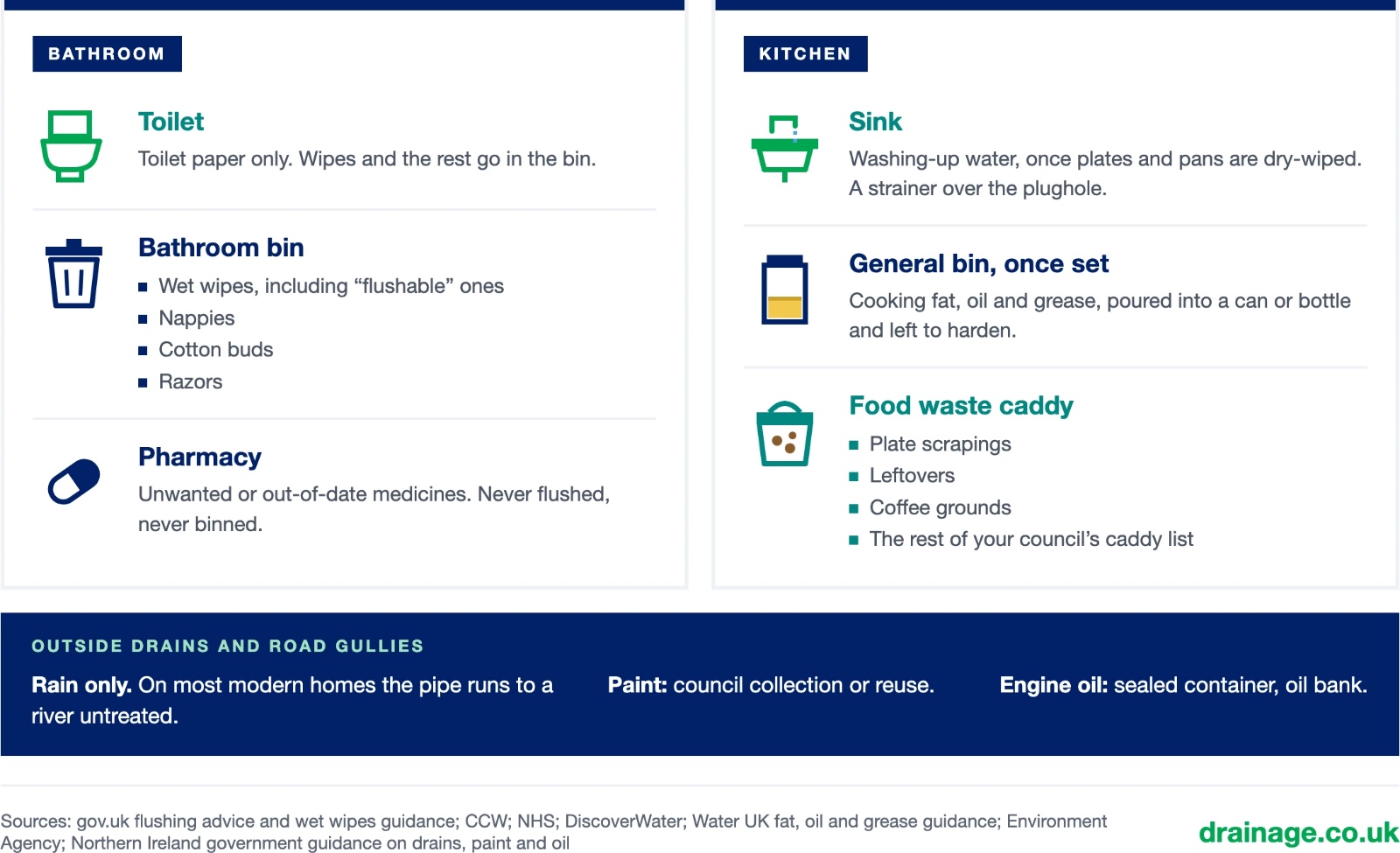
Over 300,000 sewer blockages occur in the UK every year, according to Water UK, the trade body for the UK's water and sewerage companies. Up to 70% of them are caused by fat, oil, grease and other material disposed of incorrectly down drains. Clearing them, and cleaning up the flooded properties and pollution they cause, costs approaching £200 million a year.
Research for the water industry found that wet wipes contribute to 94% of sewer blockages.
DiscoverWater, the water industry's public data site, recorded 4,808 incidents of properties being internally flooded by sewage in England and Wales between April 2024 and March 2025, with the wrong things going down the toilet an increasing cause.
A home drain is usually no more than 100mm across, about four inches.
This guide sets out what goes down the toilet and the sink, what goes in the bin, the food caddy or back to the pharmacy instead, when the plastic wet wipe ban starts in each nation, and who pays when a blockage is traced back to you.
Toilet paper is the only product to flush
Government advice is that toilet paper is the only product that should ever be flushed.
CCW, the independent body that represents water customers in England and Wales, lists wet wipes and nappies among the items that should never be flushed and go straight in the bin. Your bin is also the place for:
- Baby wipes and cleaning wipes
- Cotton buds
- Syringes
- Razors
Plastic-stemmed cotton buds have been banned in England since 1 October 2020, and a paper-stemmed bud still needs to go in the bin.
Medicines go back to the pharmacy. Out-of-date or unwanted medicine should not be put in the bin or flushed down the toilet. Take it to a pharmacy, which will dispose of it safely.
Wet wipes and other unflushables mix with congealed fat in the sewer to form fatbergs that block sewers. The wipe comes from the bathroom and the fat comes from the kitchen.
Flushable wipes and the plastic wet wipe ban
Many wipes are sold as "flushable". Any wet wipe, "even if they are labelled as flushable", goes in the bin, because many wipes marketed as flushable do not break down quickly in sewers.
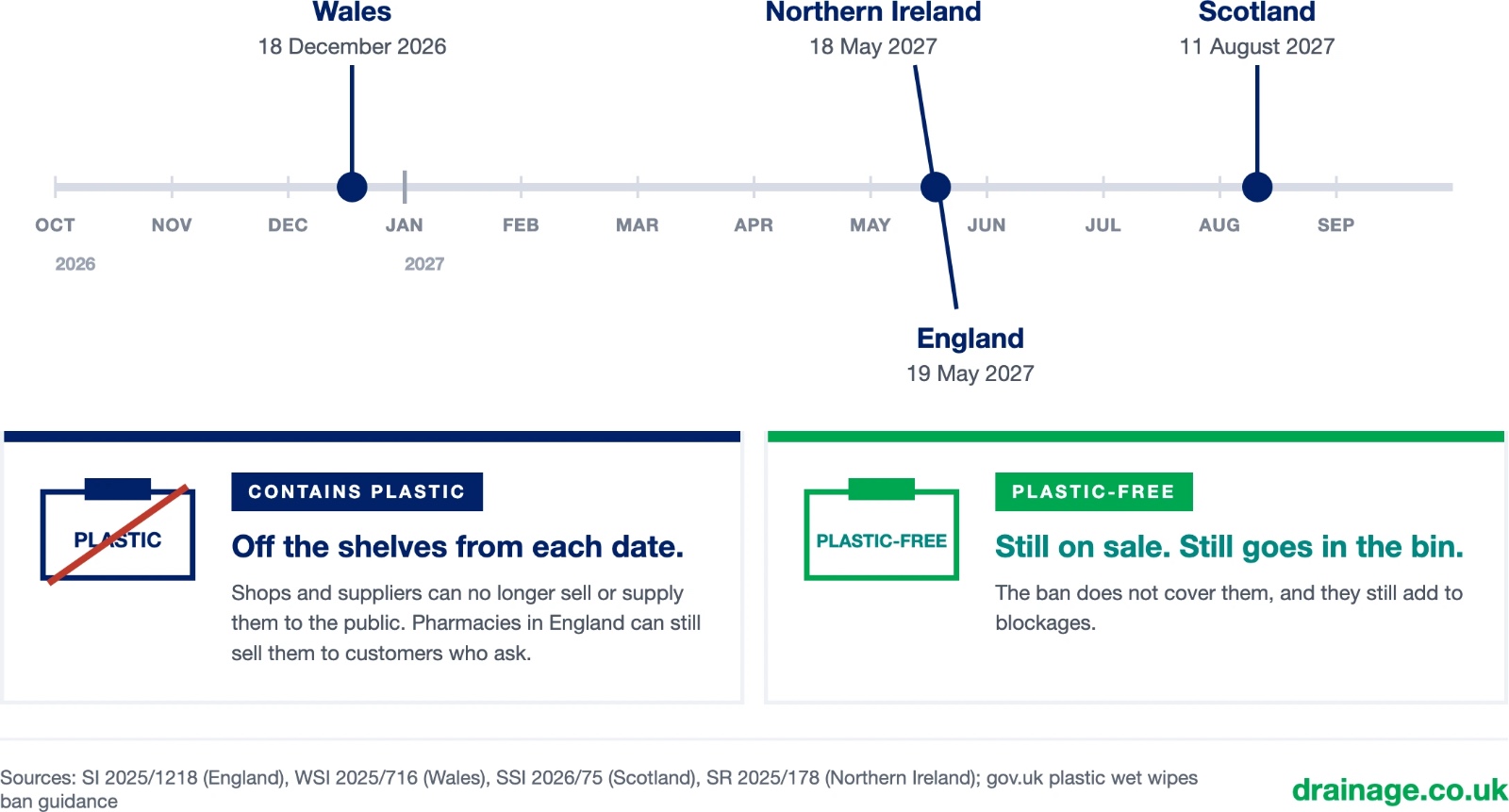
Each of the four UK nations has now passed a law banning the sale and supply of wet wipes that contain plastic. The start dates differ:
- Wales: from 18 December 2026
- Northern Ireland: from 18 May 2027
- England: from 19 May 2027
- Scotland: from 11 August 2027
The ban applies to businesses that sell or supply wipes. In England it stops a business supplying or offering to supply wet wipes containing plastic to an end user.
Supplying them is a criminal offence, and local authorities carry out the inspections. A council can instead impose a fixed monetary penalty of £200, cut to £100 if paid within 28 days of the notice of intent.
In England, registered pharmacies can still sell wipes containing plastic to customers who ask for them, and wipes for medical use are still permitted.
Plastic-free wet wipes are not included in the ban. All wet wipes contribute to blockages and pollution when flushed, whatever they are made from, so a plastic-free wipe should still go in the bin.
The ban targets the plastic that ends up in rivers and on beaches. Between 2015 and 2020, beach litter monitoring found an average of 20 wet wipes on every 100 metres of UK beach surveyed.
Fat, oil and grease: the kitchen sink
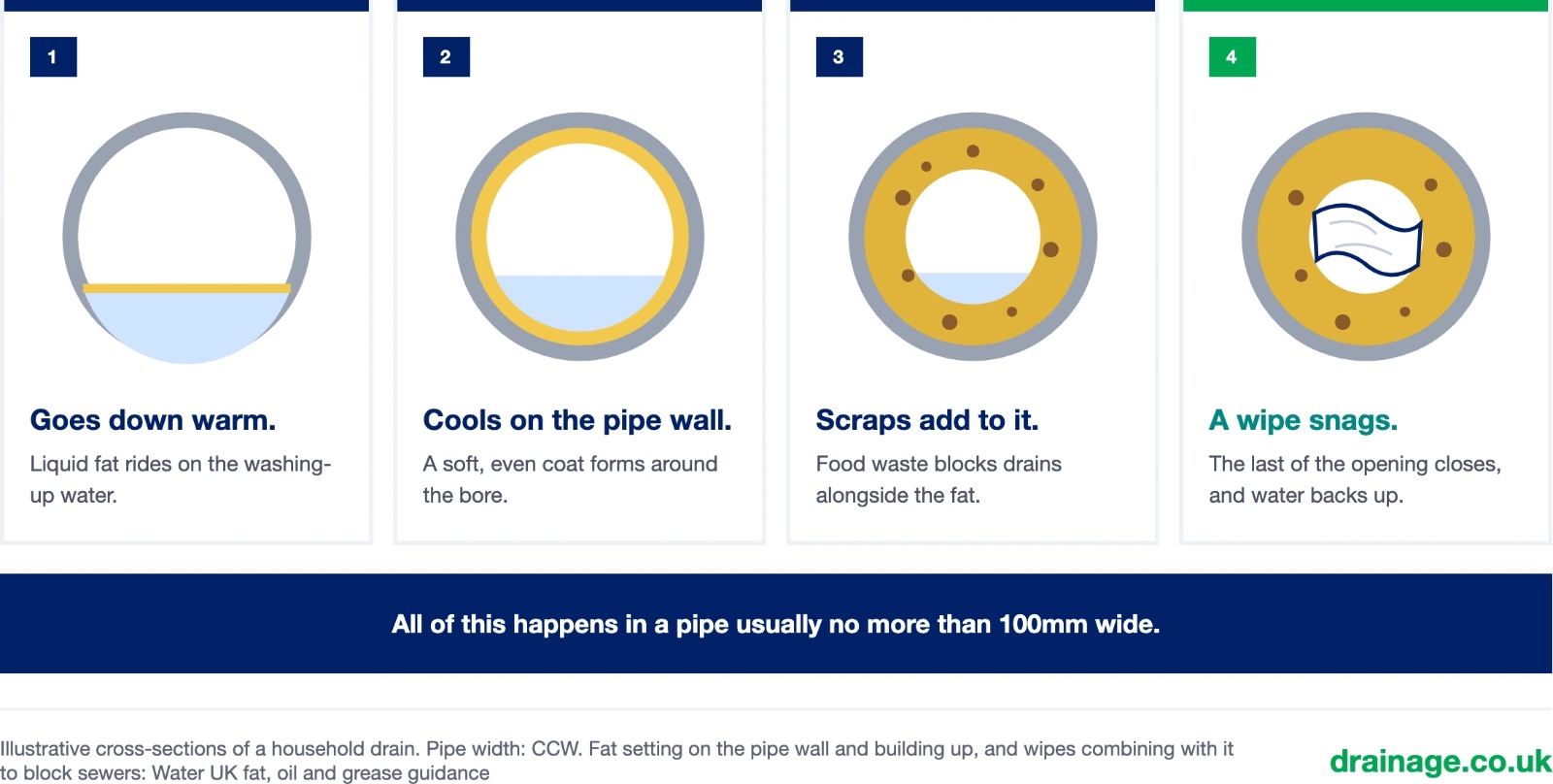
Fat goes down a sink as a liquid. Neither animal fat nor vegetable oil dissolves in water, and as they cool they set and harden. The fat sticks to the inside of the pipe, and over time the build-up narrows it until it blocks.
Warm water keeps the fat liquid for longer, and liquid fat can travel through the network before it sets. Detergent and bleach only help for a short time, because the mixture soon turns back to thick or solid fat further down the drain.
Kitchen oil, fat and grease can lead to major blockages and should not be put down the drain. In a household kitchen:
- Let it cool, pour it into a can or bottle, let it harden, and put it in the bin.
- Ask your sewerage company for a fat trap. They are provided free of charge.
Before washing up, scrape plates, pots and utensils and dry-wipe them with a kitchen towel. Put the scrapings in the food waste bin, and fit a strainer over every plughole.
Fat comes from oils, meat, fish and dairy products, and it is also present in leftover food on plates.
Sodium hydroxide, used in household drain cleaners, can cause pain, burns and ulcers on contact with the skin in stronger solutions. If you have used a chemical cleaner on a blocked sink, tell our engineer before they open the trap.
Workplaces in England are told you must never put cooking oil down the drain. Our guide to commercial drainage compliance covers grease separators and what an environmental health officer checks in a commercial kitchen.
Food scraps, coffee grounds and the food waste caddy
Food scraps block drains too. Other food waste can enter and block drains and sewers, and food scrapings belong in the bin, not the sink.
From 31 March 2026, councils in England must collect food waste from every household at least once a week, free of charge. Some councils agreed a later start date for food waste under transitional arrangements, so check with yours if a caddy has not arrived yet.
The weekly duty is written into section 45A of the Environmental Protection Act 1990. In Wales, the Welsh Government's collections guidance sets a weekly separate food waste collection as the standard.
Plate scrapings, leftovers and anything scraped from pans go in the food waste bin. Your council publishes the list of what its caddy takes.
Keep coffee grounds out of the sink, including the grounds from a cafetière. Food businesses are told to collect the grinds from coffee machines separately, so they do not escape into the waste water system. Check your council's list for whether grounds go in the caddy.
Food waste disposers, which send ground-up food down the drain, are restricted outside the home in two nations. In Wales, occupiers of non-domestic premises must not discharge food waste into a public sewer.
In Scotland, anyone who produces food waste, other than households and properties in rural areas, has been under a duty to keep food waste out of the sewer since 1 January 2016. Both rules exempt homes.
Outside drains usually run straight to the river
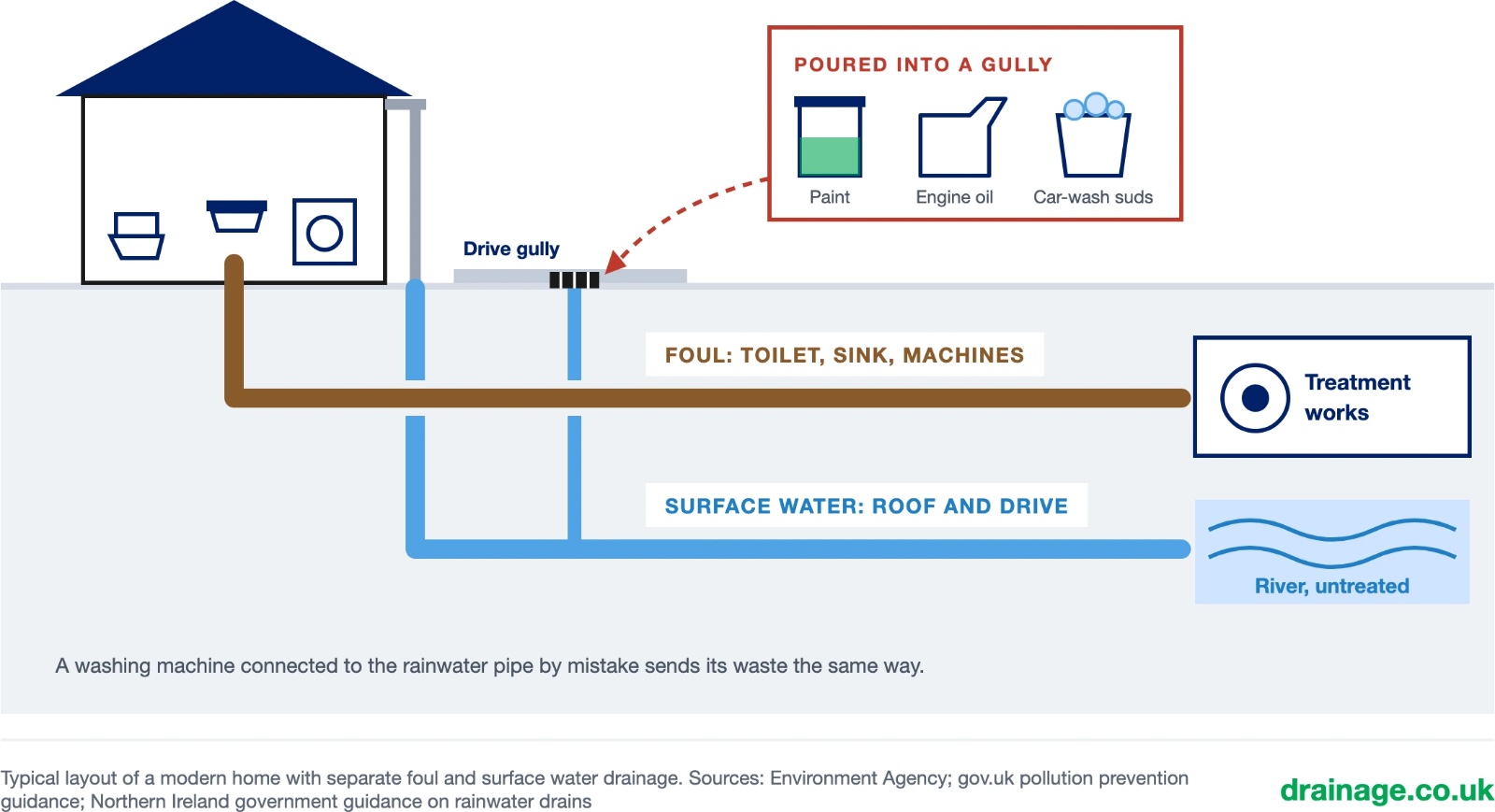
Most properties built since 1970 have separate drains: a foul pipe that takes the toilet, sink and washing machine to a treatment works, and a surface water pipe that takes rain off the roof, drive and road into rivers and lakes untreated. An older property may have a single combined pipe that carries both.
On a separate system, rainwater drains and road gullies belong to the surface water side, and surface water drains discharge directly to the environment.
Northern Ireland government guidance lists what should never go into a rainwater drain or road gully:
- Cooking fat, oil and grease
- Chemicals
- Paint
- Detergent
- Bleach
Paint goes to your council. Leftover paint can be disposed of through your local council or donated to a paint reuse network. Check your council's own page for how it takes paint.
Engine oil goes to a waste oil bank, in an undamaged container with a secure lid, and is never poured down a drain or onto the ground.
Car washing sends detergent off the drive, and detergent should never go into a rainwater drain or road gully. Wash the car where the water runs onto grass, or use a car wash.
A house can also send sewage the wrong way through a misconnection, where a washing machine, dishwasher or toilet is connected to the surface water pipe by mistake. A 2019 estimate put the number of UK households that may have one at between 150,000 and 500,000. Fixing a misconnection is legally the property owner's responsibility.
Causing or knowingly permitting a water discharge activity without a permit is an offence under regulation 38 of the Environmental Permitting (England and Wales) Regulations 2016. On conviction on indictment it carries up to five years' imprisonment, a fine, or both.
Septic tanks and treatment plants
A property on a septic tank or small treatment plant has its own rules about what the system can take. In England, the general binding rules for small sewage discharges require the sewage to be only domestic, and the discharge must not cause pollution of surface water or groundwater.
If a significant proportion of what a home discharges is different from normal household sewage, it is classed as a mixture of domestic sewage and other polluting matter. The general binding rules only cover sewage that is domestic.
Waste sludge must be disposed of by an authorised person. The tank should be emptied at least once a year or in line with the manufacturer's instructions.
Our guide to buying a house with a CCTV drain survey covers what a buyer should ask for when a property drains to a tank.
Who pays when something you flushed blocks the drain
Where the blockage sits decides who pays. In England, you are usually responsible for the drains inside your property boundary, and you pay to have work done on them. The sewerage company is responsible for lateral drains, which usually run outside the boundary, and for the sewers.
That split dates from 1 October 2011, when shared private sewers and lateral drains in England transferred to the water companies. A drain serving one property and sitting inside its boundary stayed with the owner.
In England, a wipe blocking the private drain under your garden is therefore usually yours to pay to clear. Our guide to who is responsible for a blocked drain sets out how to tell which side of the line a blockage is on.
Section 111 of the Water Industry Act 1991 says no person shall pass into a public sewer, or a drain connected to one, any matter likely to injure it or "to interfere with the free flow of its contents". The offence applies in England and Wales to any person, households included, and carries a fine on summary conviction and up to two years' imprisonment on indictment.
Where a water company has spent money removing a blockage from its sewer, or dealing with the flooding or pollution the blockage caused, it can take legal action to recover those costs.
If you rent, your landlord is always responsible for repairs to sinks, baths and other sanitary fittings, including pipes and drains. Damage is handled separately. A protected deposit comes back in full when the tenant has met the tenancy terms and not damaged the property. Our landlord's guide to drainage responsibilities covers the landlord's side of the same rule.
On insurance, the Financial Ombudsman Service, which settles disputes between customers and insurers, can treat a blocked pipe as damaged even if there's no physical damage to the pipe, because water is unable to flow through it. Every policy is different. Our guide to drain damage and insurance covers what buildings cover pays for and the report an insurer needs.
How Drainage.co.uk clears a blocked drain and finds the cause
Drainage.co.uk clears blocked drains 24 hours a day across the UK, from dispatch hubs in more than ten cities, with a 60-minute emergency arrival target. The work is backed by ISO 9001 certification and SafeContractor accreditation.
A blockage made of fat and wipes is cleared with high-pressure water jetting, which scours the set layer off the pipe wall along the full length of the run.
Where a drain keeps blocking, a CCTV drain survey shows why. The camera records what the blockage is made of, where it sits along the run, and whether the pipe itself has a defect that catches waste, such as a displaced joint, a dip or root ingress. A drain that blocks again after clearing is one of the early signs of a failing drain.
The survey report also places the fault against your boundary. Where it sits on a lateral drain or a public sewer, the report gives the water company what it needs to take the job on.
For landlords, letting agents and managing agents, the same report records what caused the blockage. For commercial kitchens, planned jetting keeps grease out of the run between separator services.
A camera survey shows what is blocking a drain and whose pipe it is in.
If your drain is blocked, or keeps blocking after it has been cleared, book a drain unblocking or CCTV survey.
Frequently asked questions
What can you flush down a toilet in the UK?
Toilet paper is the only product that should be flushed, according to government advice. Wipes and nappies go in the bin, as do cotton buds and razors, and unwanted medicines go back to a pharmacy.
Can you flush wipes labelled "flushable"?
No. Any wet wipe goes in the bin, even one labelled as flushable, and many wipes marketed as flushable do not break down quickly in sewers.
When does the UK wet wipe ban start?
Sale and supply of wet wipes containing plastic will be banned from 18 December 2026 in Wales, 18 May 2027 in Northern Ireland, 19 May 2027 in England and 11 August 2027 in Scotland. Plastic-free wipes are not included in the ban, and because all wet wipes contribute to blockages, they still go in the bin.
How do I get rid of cooking oil at home?
Let it cool, pour it into a can or bottle, let it harden and put it in the bin. You can also ask your sewerage company for a free fat trap. Dry-wipe greasy pans with a kitchen towel before washing them.
Is it OK to put coffee grounds down the sink?
Keep them out of the sink, and check your council's list for whether they go in the food waste caddy. Food businesses are told to collect coffee grinds separately so they do not escape into the waste water system. In England, councils must now collect food waste weekly from households, subject to transitional arrangements in some areas.
Can I pour paint or oil down an outside drain?
No. On a separate system, rainwater drains and road gullies take their water into rivers and lakes without treatment. Paint goes to your council and engine oil to a waste oil bank. In England and Wales, causing or knowingly permitting a water discharge activity without a permit is an offence under the Environmental Permitting Regulations.
Who pays if my tenant's wipes block the drain?
The landlord is always responsible for repairs to pipes and drains. A protected deposit comes back in full when the tenant has not damaged the property, and a survey report records what caused the blockage. Our landlord's guide to drainage responsibilities covers the full split.
Is it illegal to put fat down the drain?
In England and Wales, passing matter into a public sewer, or a drain connected to one, that is likely to interfere with its flow is an offence under section 111 of the Water Industry Act 1991. Businesses in England are told directly that they must never put cooking oil down the drain.
Who is responsible for a blocked drain caused by something I flushed?
It depends on where the blockage sits. In England, a drain inside your boundary is usually yours to pay for. The water company is usually responsible for lateral drains and public sewers. Our guide to who is responsible for a blocked drain explains how to tell the difference.
Technical
Directives.
Our hub maintains precision unblocking protocols across the UK. For immediate site remediation, contact our dispatch specialists.