Buying a House? Why a CCTV Drain Survey Could Save You Thousands
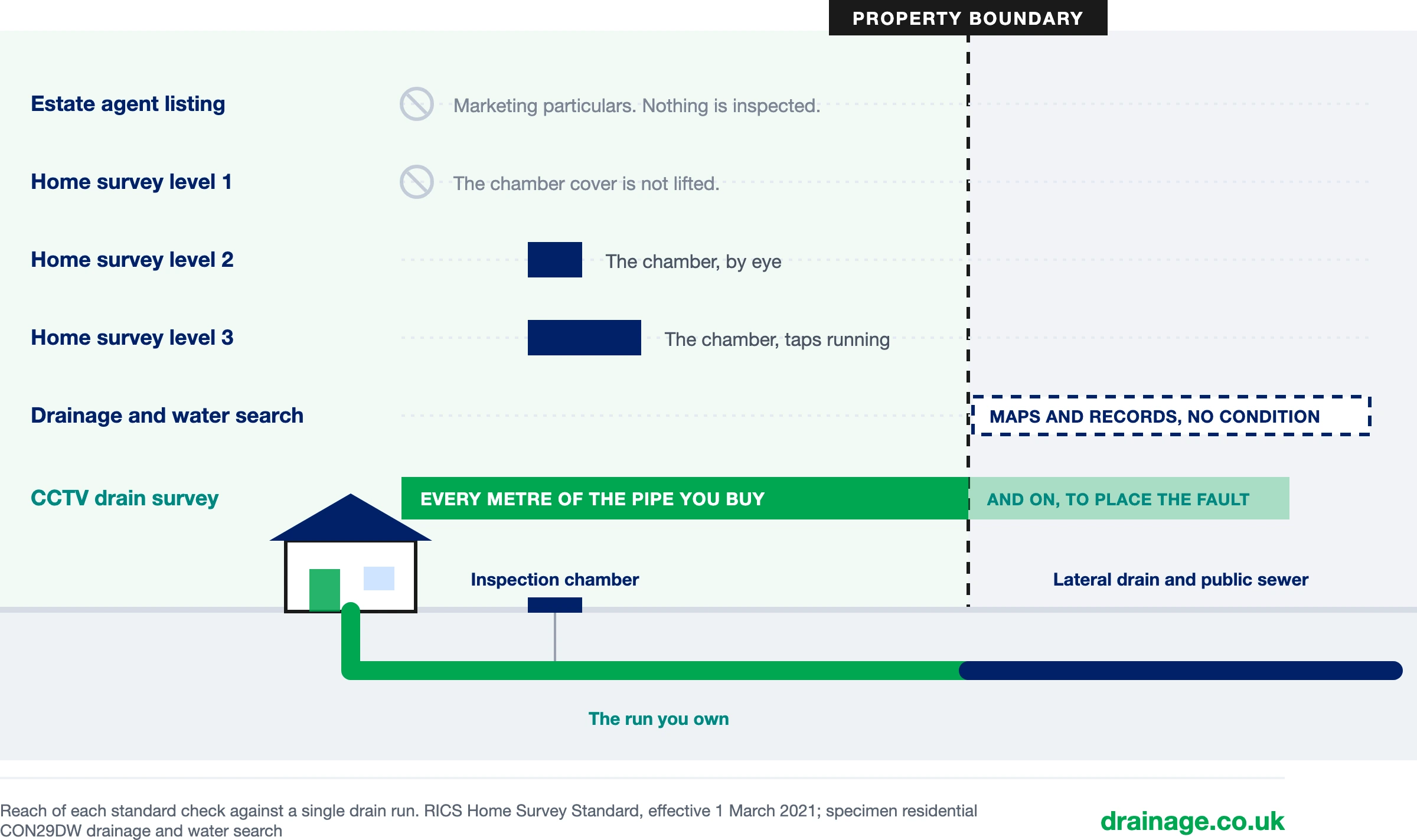
For a standard UK house purchase, most people only look at two things. The inspection survey is an inspection of what can be seen. The drainage and water search is a set of answers about the public network, drawn from the water company's records.
Between them they cover the roof, the walls, the damp, the boundary and the billing, but the pipe running under the garden is inspected by neither.
That pipe is where the expensive faults sit. Water UK data published through DiscoverWater recorded 4,808 incidents of properties being internally flooded by sewage, and 50,281 incidents of private land or gardens being flooded, between April 2024 and March 2025.
At the far end of the same problem sits the ground itself. The British Geological Survey names leaking drainage pipes as a documented trigger of ground collapse, and the Association of British Insurers put the average subsidence claim at a record £20,000 in Q2 2026.
This guide sets out what the standard checks do and do not cover, what you inherit at completion, and what a defect found before exchange is worth at the negotiating table.
What your survey does with the drains
The Home Survey Standard has been in effect since 1 March 2021 and sets out what a surveyor does on site. It is published by RICS, the professional body that writes the rules UK surveyors work to.
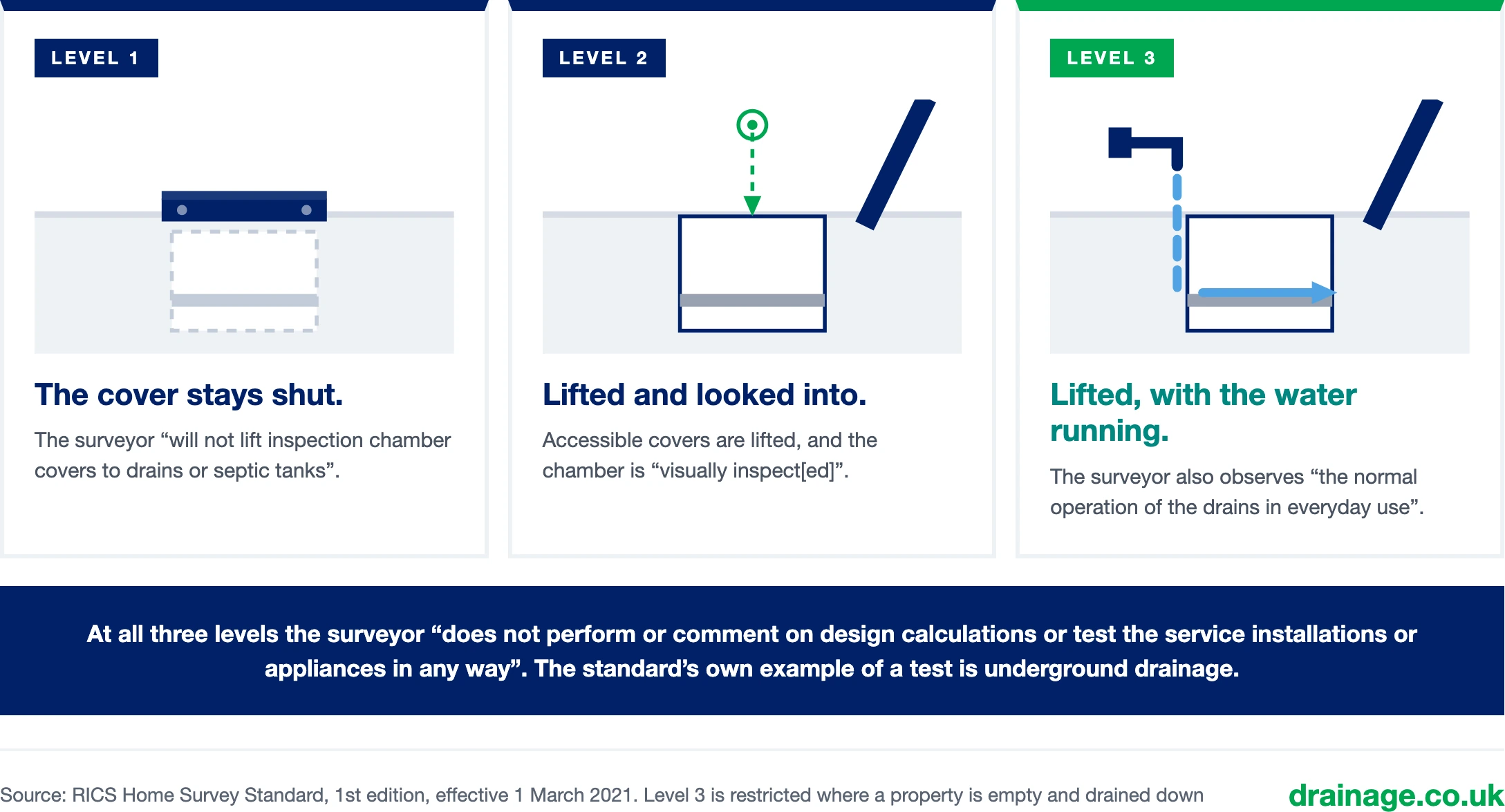
The rule that applies at every level is the same: the surveyor "does not perform or comment on design calculations or test the service installations or appliances in any way." The standard then defines a test as "checking the performance of a service system," and the example it gives, in its own glossary, is underground drainage.
The three levels diverge only on how far the visual inspection goes:
- Level 1. The surveyor "will not lift inspection chamber covers to drains or septic tanks."
- Level 2. The surveyor "will lift accessible inspection chamber covers to drains or septic tanks (where it is safe to do so and without causing damage) and visually inspect the chamber(s)."
- Level 3. The surveyor lifts accessible covers "and observe[s] the normal operation of the drains in everyday use," usually by running taps and flushing toilets so the visible pipework can be watched.
An empty property narrows even that. The standard notes the Level 3 check "will be restricted where properties are empty and drained down."
In place of a test, the standard requires the member to advise the client "that further tests and inspections will be required if the occupier does not provide evidence of appropriate installation and/or maintenance, or the client requires assurance as to their condition, capability and safety." The recommendation to get the drains looked at is written into the standard itself.
RICS is drafting a 2nd edition of the Home Survey Standard and has said an updated publication timeline will be shared as the draft develops. The 1st edition governs the survey you commission today.
What the drainage search tells you, and where it stops
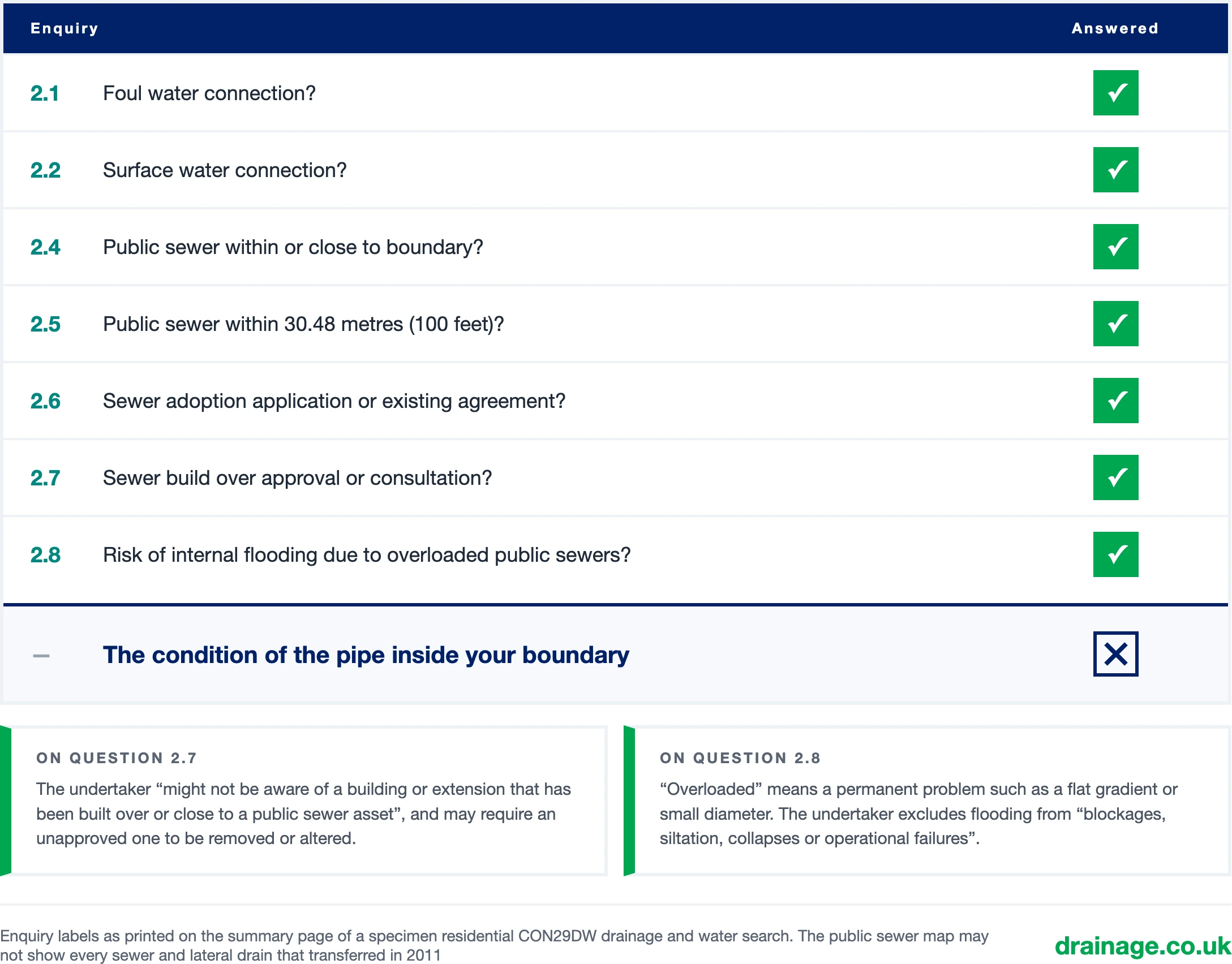
The CON29DW drainage and water search is the standard conveyancing enquiry your solicitor raises with the water company. It runs to four sections of enquiries, plus a map of the public sewer network and a map of the public water network. A specimen residential CON29DW shows what it asks:
- Whether the property has a foul water connection and a surface water connection (questions 2.1 and 2.2).
- Whether the public sewer map indicates a public sewer, disposal main or lateral drain within the boundaries of the property (2.4), and whether one lies within 30.48 metres (100 feet) of any buildings on it (2.5).
- Whether a sewer adoption application or agreement exists (2.6), which is the question that matters on a new build.
- Whether the sewerage undertaker approved or was consulted about building over a sewer (2.7).
- Whether the property is at risk of internal flooding from overloaded public sewers (2.8).
Every one of those answers concerns the public network or the paperwork attached to it, and none describes the condition of the pipe you are buying.
Two limits sit behind a clean set of answers.
The first is the flooding question. The specimen defines an overloaded sewer as one where storm flow cannot pass "due to a permanent problem like the sewer having a flat gradient or small diameter," and states that the undertaker "does not include flooding from temporary problems such as blockages, siltation, collapses or operational failures."
A property that has been flooded by a collapsed sewer can still answer "no" to question 2.8.
The second is the map. The public sewer map "may not show all of the sewers and lateral drains that transferred into public ownership on the 01 October 2011." A pipe can be absent from the map and still be sitting under the garden.
The pipe you inherit
Ownership of drainage changed on 1 October 2011, when eligible private sewers and lateral drains transferred to the water companies. The effect for a buyer is that the run you take on is short, and completely yours. Our guide to who is responsible for a blocked drain sets out where that line falls.
The CON29DW specimen lists what stayed in private hands, and each item is a cost a buyer can inherit without noticing:
- The private drain. The section of pipe inside the boundary serving only the property. Yours from completion, whatever condition it is in.
- Private pumping stations. Eligible pumping stations transferred by 1 October 2016, but one located within the boundary and serving a single property stayed private. Maintaining and replacing it is the owner's cost.
- Soakaways and sustainable drainage features. Ponds, swales and soakaways "remain private and do not currently form part of the public sewer network." Soakaways are also not usually covered by a buildings policy, because they are not pipes, drains or tanks.
- Septic tanks, cesspits and private treatment works. Private in full, along with the pipework serving them.
Extensions, conservatories and the sewer under the garden
According to the CON29DW, the specimen answer for a property with no record on file reads: "There is no record of any approval or consultation to build over or near a public sewer asset at this property." It then adds that the sewerage undertaker "might not be aware of a building or extension that has been built over or close to a public sewer asset at the property."
So an extension can sit over a public sewer with no approval, and the search will report nothing. The consequence falls on whoever owns the house when it surfaces. Where approval was needed and not obtained, the undertaker "may ask the homeowner to remove or alter a building which has been built over or near a public sewer asset without approval."
The underlying requirement is H4 of Schedule 1 to the Building Regulations 2010, which applies to building work over a drain, sewer or disposal main "shown on any map of sewers", and to work that would interfere with its use or obstruct any person's access to it. An extension, a conservatory or an outbuilding engages the first limb. Work that obstructs access to a chamber engages the second.
A public sewer inside the boundary also sets what consent a future extension needs, and that constraint comes with the deeds.
Buying a property that is not on the public sewer
A property that drains to a tank instead of a sewer carries a set of duties that transfer with it. The general binding rules for small sewage discharges, enforced by the Environment Agency, the regulator for water discharges in England, govern how a septic tank or small treatment plant must be run. Four points decide whether you are inheriting a working system or a project.
The seller owes you a written handover. Rule 13 states that when a property is sold, the operator must give the new operator "a written notice stating that a small sewage discharge is being carried out, and giving a description of the waste water system and its maintenance requirements." Ask for it before the exchange. Where the seller cannot produce one, ask for the desludging invoices instead.
A septic tank cannot discharge to a watercourse. Where it does, the Environment Agency route is to connect to a public foul sewer, replace the tank with a small sewage treatment plant, or install a drainage field. That work becomes the buyer's on completion.
A discharge must not sit within 30 metres of a public foul sewer. Where one does, the discharge falls outside the rules and the property is expected to connect to the sewer.
Volume and character set the permit line. The binding rules cover a discharge of 2 cubic metres or less a day to ground, or 5 cubic metres or less to surface water, and apply only to domestic sewage. Beyond either limit the site needs an environmental permit.
The claim you cannot make after you complete
Most building policies cover underground pipes you are legally responsible for. The exclusions are where drain claims are decided, and the Financial Ombudsman Service, the body Parliament set up to settle disputes between customers and financial firms, names the most common as gradual damage, wear and tear, and poor design, construction or workmanship.
A gradual damage exclusion is harder for an insurer to sustain where the customer could not reasonably have been aware of the damage happening.
Wear and tear is treated differently, because everything wears out eventually and a policy cannot protect a customer from that. An original clay run that reaches the end of its service life shortly after you move in is exactly what that exclusion is there to cover.
Sellers are required to disclose what they know. Omitting information the average consumer needs to make an informed transactional decision is a misleading omission under section 227 of the Digital Markets, Competition and Consumers Act 2024, which replaced the Consumer Protection from Unfair Trading Regulations 2008 and applies to estate agents as it does to any other trader.
That duty only reaches as far as what the seller knows. A buried pipe is the part of a house a seller is least likely to have any information about.
Our guide to drain damage and insurance covers what a policy pays for and the evidence an insurer needs. The survey report you commission before exchange is also the dated record of the pipe's condition on the day you took it on.
What a CCTV survey finds
The camera returns four things a visual inspection cannot: the defect itself, its position measured along the run, the pipe material and the points where one material changes to another, and a diagram of the layout.
Common findings are displaced or open joints, root ingress, cracked or fractured pipework, bellied sections holding standing water, insufficient fall, and collapse. These are the same early signs of a failing drain that show up indoors later as a blockage that keeps coming back.
When to book it, and what to do with the report
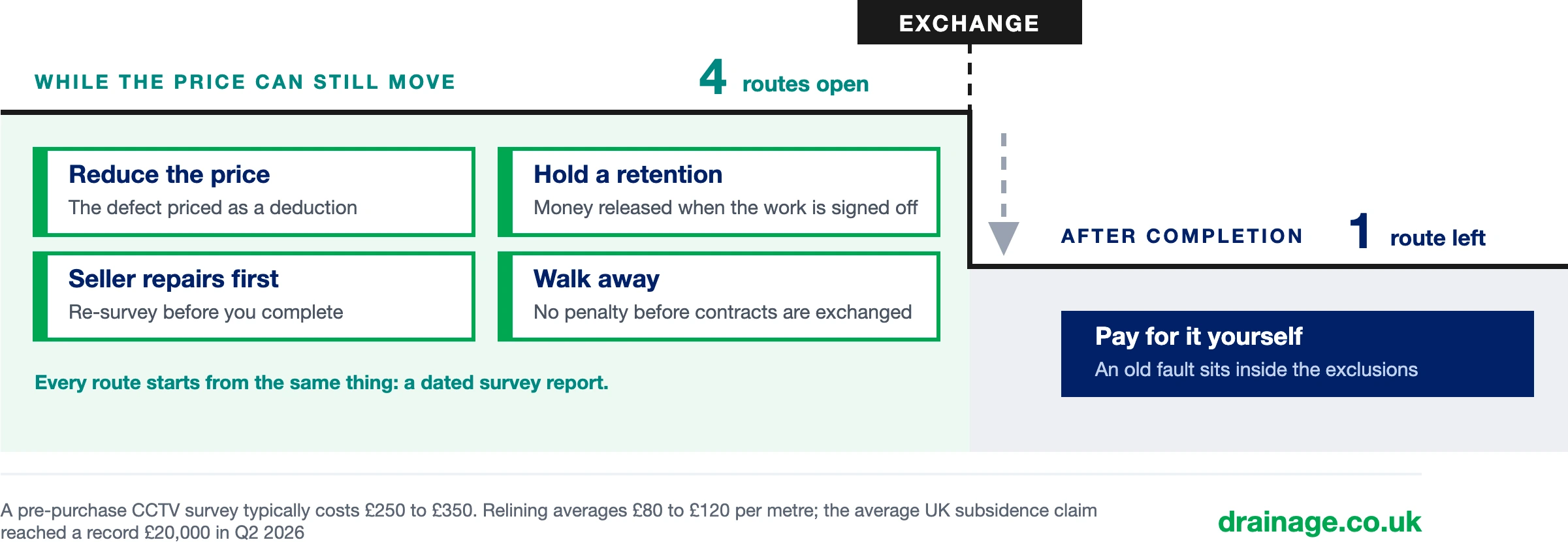
Book the drain survey alongside the building survey, once your offer is accepted and before exchange. At exchange the agreement to sell and buy becomes legally binding, and neither side can usually pull out after that without paying compensation. Until exchange, the price can still move.
A defect found before exchange gives you four routes:
- Reduce the price by the cost of the repair, supported by the report and a quote.
- Ask for a retention, where a sum is held back from the purchase price until the work is done.
- Require the seller to fix it before completion, with the repair evidenced by a post-works survey.
- Walk away, where the report shows a collapsed run under a structure.
After completion the same defect gives you one route: pay for it.
Where the camera shows the fault sits beyond the boundary, on a lateral drain or a public sewer, the repair falls to the water company at their cost. The report establishes that before you have committed to the purchase.
How Drainage.co.uk surveys a property before you buy it
Drainage.co.uk runs pre-purchase CCTV drain surveys nationally, from dispatch hubs in more than ten cities, with ISO 9001 certification and SafeContractor accreditation behind the work.
A pre-purchase survey produces the report a solicitor and an insurer can both work from: a pipework diagram, a defect list referenced by run and distance, the pipe material and its change points, and footage of each defect.
Where the survey finds a fault, the same team quotes the repair, including trenchless CIPP relining that fixes a failing run without excavating the garden you are about to buy. Where the fault sits on an adopted sewer, the report gives the water company what it needs to take the job on.
Buying a house? Survey the drains before you exchange.
If you want the drains on a property you are buying surveyed before you commit, book a pre-purchase CCTV survey.
Frequently asked questions
Does a house survey include the drains?
Not in the way buyers expect. The Home Survey Standard states that the surveyor does not test service installations in any way. A Level 1 survey does not lift inspection chamber covers at all, a Level 2 lifts accessible covers and inspects the chamber visually, and a Level 3 also watches the drains run in everyday use. No level puts a camera into the pipe.
Does the drainage and water search cover the condition of the drains?
No. The CON29DW answers a fixed set of enquiries about the public network, connections, sewers within or close to the boundary, adoption agreements, build-over records, flooding risk and billing, and provides a public sewer map and a public water map. Its scope is the public network and the records attached to it, so the state of your own pipework is not assessed.
The search says there is no risk of internal flooding. Is that a guarantee?
It is narrower than it looks. The specimen CON29DW confirms that the question covers sewers permanently overloaded by a flat gradient or small diameter, and that the undertaker excludes flooding from blockages, siltation, collapses and operational failures.
What happens if the previous owner built an extension over a public sewer?
The obligation passes to you with the house. The sewerage undertaker "may ask the homeowner to remove or alter" a building put up over or near a public sewer without approval, and the search will not reveal an unapproved build because the undertaker "might not be aware" of it. The underlying requirement is H4 of Schedule 1 to the Building Regulations 2010.
What should I ask for when buying a house with a septic tank?
The written notice the seller is required to give you under rule 13 of the general binding rules, describing the system and its maintenance requirements, plus desludging records. Then confirm the discharge does not go to a watercourse, is not within 30 metres of a public foul sewer, and sits inside the volume limits.
Can I claim on my insurance for a drain fault I discover after moving in?
Often not. Gradual damage, wear and tear, and poor design, construction or workmanship are named as the most common exclusions on underground pipe claims, and a pipe that was already deteriorating before you bought the house fits the first two. A dated pre-purchase survey establishes the condition the property was in when you took it on.
When in the buying process should I book a drain survey?
After your offer is accepted and before exchange, alongside the building survey. Before exchange a defect can be met with a price reduction, a retention, a seller repair or withdrawal. After completion the repair is yours.
Who pays if the fault turns out to be beyond the property boundary?
The water company. Lateral drains and sewers connected to the public network transferred to the water companies in 2011, and a fault past the boundary is theirs to fix at their cost. Our guide to who is responsible for a blocked drain sets out the boundary rule in full.
Technical
Directives.
Our hub maintains precision unblocking protocols across the UK. For immediate site remediation, contact our dispatch specialists.