Drain Damage and Insurance: What UK Property Owners Need to Know Before Filing a Claim
A drain fault turns into an insurance question the moment the repair quote arrives. Most property owners assume their building's policy covers it, then find out at claim stage that the answer depends on where the pipe sits, what caused the fault, and what evidence they can produce.
FCA general insurance value measures data published in July 2026 puts home insurance claims acceptance at 62–71%, against 99% for motor insurance, with buildings-only policies sitting at the bottom of that range at 62%. Complaints about home insurance claims run at 7–13% of claims registered, while most other retail insurance products sit between 0% and 6%.
The FCA adds that firms report home claims acceptance inconsistently, so the rate should be read with caution. At the Financial Ombudsman Service, buildings insurance produced 6,399 new complaints in 2025/26, and 38% of them were upheld.
This guide covers what a UK buildings policy pays for underground pipes, the exclusions that decide most drain claims, what your water company owes you, and the evidence that separates a paid claim from a declined one.
What your buildings insurance covers underground
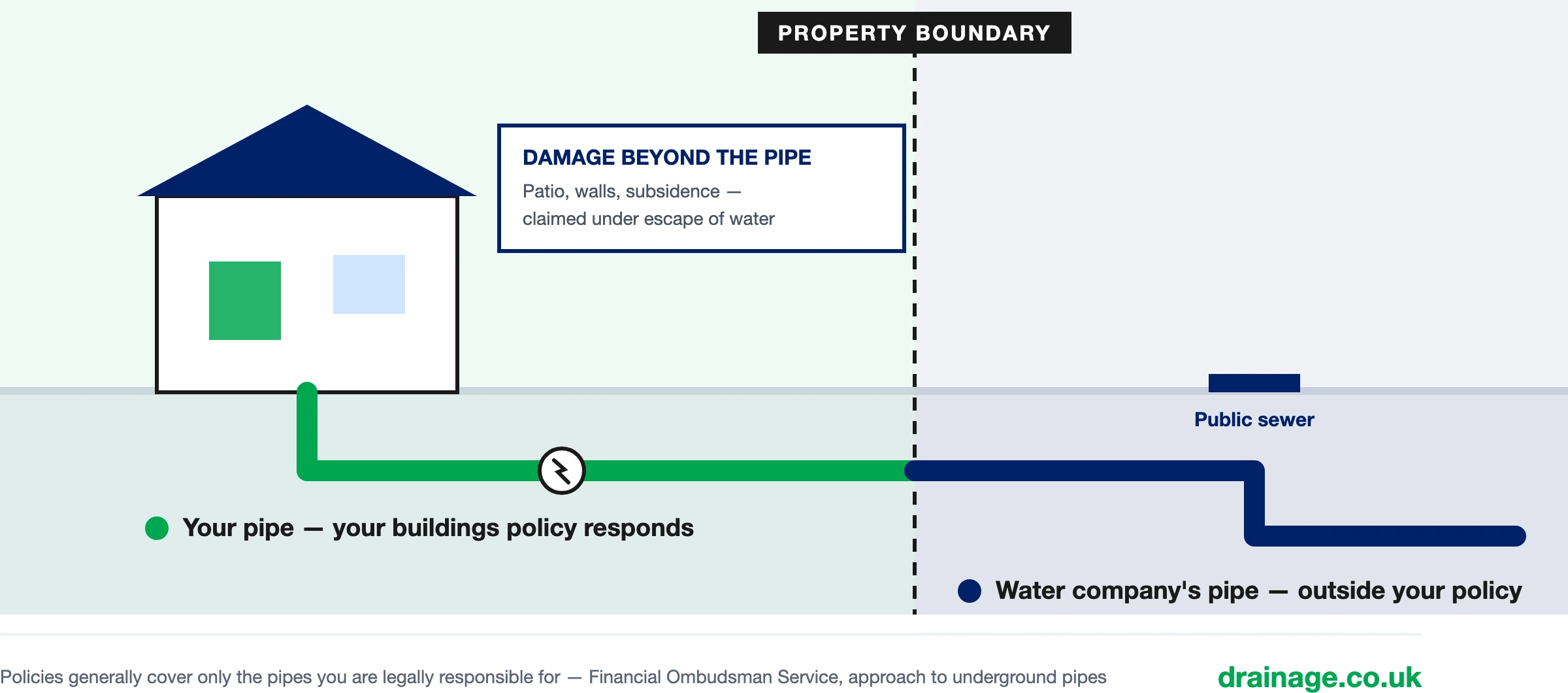
Most buildings policies include cover for underground pipes, drains, cables and tanks, a section insurers usually call underground services. However, the policies generally only cover problems with pipes the policyholder is legally responsible for, so an insurer will not cover a pipe owned by a water company or a neighbour even when that pipe is causing the problem.
That gives you a short test before you call anyone:
- It is your insurer's responsibility if the pipe sits inside your boundary and serves only your property.
- Shared and usually split if the pipe is on your land, carries a neighbour's waste, and belongs to a private system that never transferred to the water company. Sewers and lateral drains connected to the public network transferred in 2011, but pipework draining to a septic tank or private treatment plant did not. Where the pipe is still private and jointly used, an insurer may pay only half the cost and expect the neighbour to cover the rest.
- Not an insurance claim if the pipe is a lateral drain or public sewer. Your insurer has no right to repair a water company's pipe, so the fault goes to the water company instead.
Two other limits catch people out. The first is what the cover attaches to: the pipe itself. Damage beyond the pipe may be a cracked patio, a damaged wall, or subsidence under the building. That damage falls to other sections of the policy, usually escape of water or flooding.
The second limit is what falls outside the definition entirely. Soakaways are not pipes, drains or tanks, so they are not usually covered even though they block over time. Cesspits are normally excluded too.
Damage does not have to mean a crack. A drain is functionally damaged if it is blocked and water cannot flow through it, even with nothing physically broken. Insurers who decline a claim on the basis that the pipe is "serviceable" are applying a very narrow test, because a pipe can carry water and still be damaged, through a minor obstruction, a small crack, or an open joint the water flows past.
The three exclusions that decide most drain claims
Insurers give a predictable set of reasons for declining underground pipe claims: the pipe was not damaged, the damage was not accidental, the pipe was pitch fibre, the policyholder was not responsible for it, the repair happened before an inspection, or an exclusion applies.
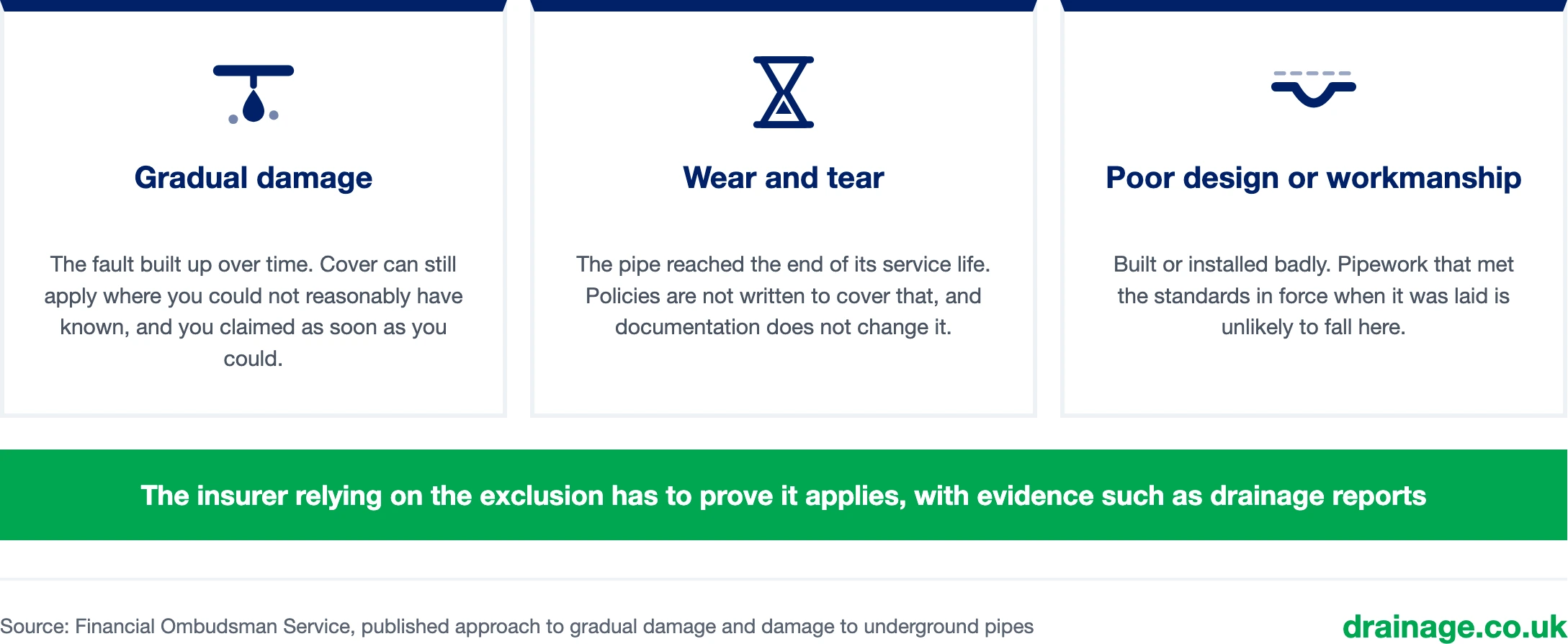
Gradual damage and wear and tear are the two most common exclusions, followed by poor design, construction or workmanship.
Where an insurer relies on an exclusion, the burden of proof sits with the insurer: it has to show the damage was most likely caused that way, with evidence such as drainage reports. A declined claim with no report behind it is a decision that is worth challenging.
A gradual damage exclusion is also harder to sustain where the customer could not reasonably have been aware the damage was happening, and where they claimed, or took reasonable action, as soon as they could reasonably have known about the problem.
Underground pipes fit that description, because the fault stays invisible until the system stops working normally. The risk runs the other way where symptoms were showing and nothing was reported. If you are seeing the early signs of a failing drain, the date you act becomes part of the claim file.
Wear and tear is treated differently. Everything wears out eventually and a policy cannot protect a customer from that, so the "could you have known" test does not rescue a wear and tear decline. Pipes at the end of their service life sit outside cover, and no amount of documentation changes that.
Accidental damage cover is an optional extra on most policies, and it covers more than the standard list of events. Where you claim under it, the argument that you could not reasonably have known about the damage carries less weight, because that cover is already much wider.
A small number of policies leave out underground pipes completely. Cover that thin is rare, so the insurer is expected to have flagged the gap when you bought the policy. Where nobody did, it may be fair for the insurer to consider the claim anyway.
When the sewer is their responsibility: what the water company owes you
If the fault is in a public sewer or a lateral drain, the payment comes from the water company under a statutory scheme. Water UK figures published through DiscoverWater record 4,808 incidents of properties being internally flooded by sewage in England and Wales between April 2024 and March 2025.
England's guaranteed standards scheme sets automatic payments for those incidents, and the amounts rose on 2 July 2025. For effluent (liquid waste or sewage discharged into a river or the sea) entering a building, the company must pay the greater of your annual sewerage charge or £300, capped at £2,000.
Where it happens again within 12 months of the last incident ending, the minimum rises by £100 and the cap by £500 for each incident already paid.
For effluent entering your land or property, the payment is 50% of the annual sewerage charge, with a £150 minimum and a £1,000 cap, rising by £50 and £250 on the same repeat basis.
Three conditions decide whether the water company pays:
- Internal flooding is paid automatically where the company can identify you. Where it cannot, you have three months from the incident to claim.
- External flooding needs a claim, and the company then has 20 working days to pay.
- Abnormal or unforeseeable events outside the company's control can remove the entitlement.
That payment answers the service failure itself. Regulation 17M of the scheme states that accepting it does not affect any other liability the company has to you, and that making it is not an admission of liability. A separate claim for ruined flooring, contents or business interruption stands on its own.
Sewer capacity is a matter for the regulator. The strict liability rule in the Water Industry Act 1991 applies to escapes from a pipe vested in a water undertaker, meaning water mains, so it does not cover sewers.
The duty to provide, improve and maintain public sewers sits in section 94 and is enforced by Ofwat or the Secretary of State under section 18, which also limits the remedies available for breaching it. Claims that stand on their own footing, such as negligence in operating or maintaining a sewer, are a separate matter from the capacity duty.
The evidence that decides your claim
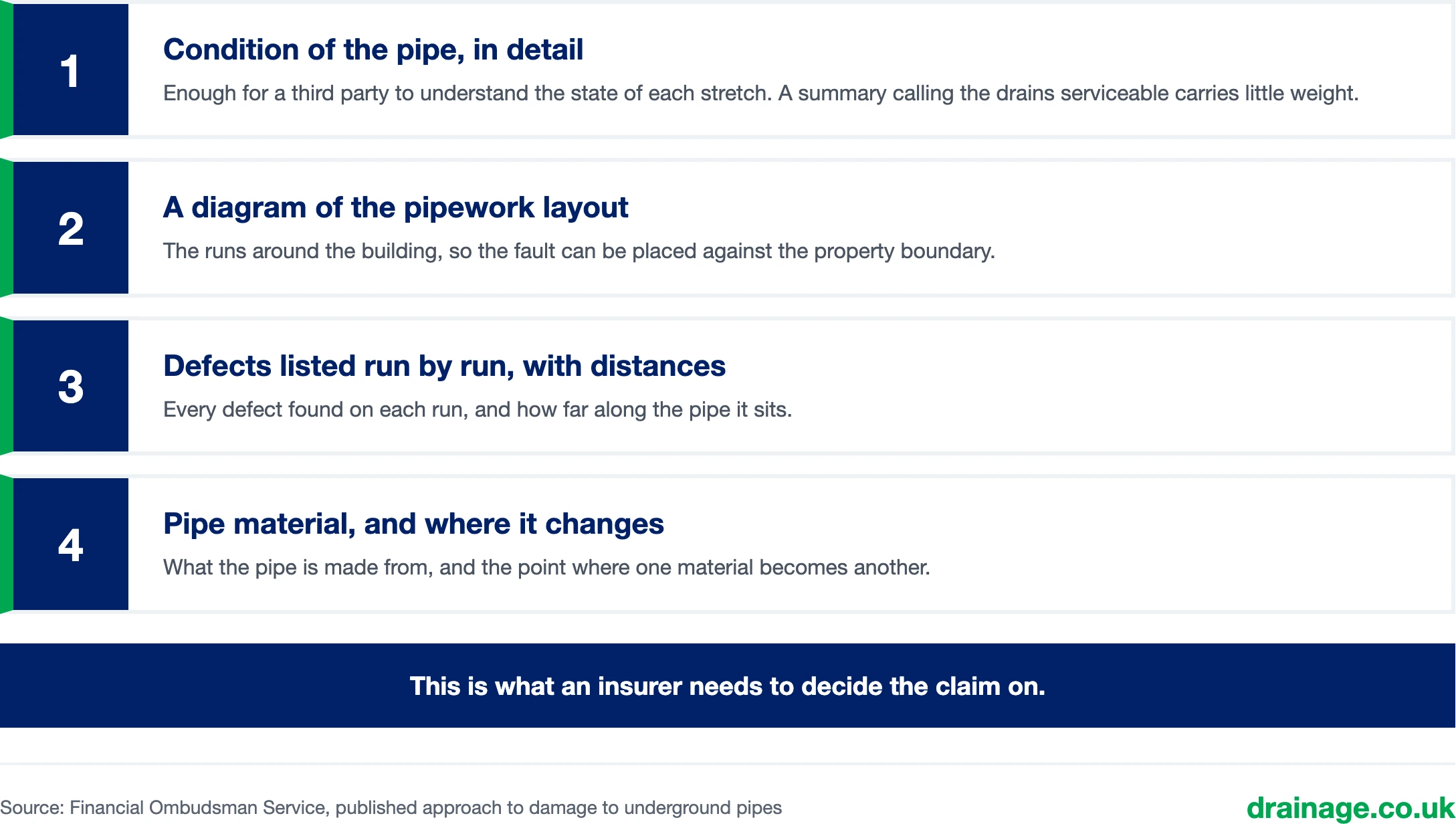
The Financial Ombudsman Service publishes what a drainage report should contain when an underground pipe claim is disputed, and the list doubles as a specification for the survey you commission. A summary saying the pipes are serviceable is unlikely to be persuasive. The full report should show:
- enough detail to understand the condition of the pipe
- a diagram of the pipework layout around the building
- a list of defects for each run of pipe, and how far along the pipe each defect sits
- the pipe material, and the points where one material changes to another
Common findings that support a claim include displaced or open joints, root ingress, cracked or fractured pipework, collapse, bellied sections and insufficient fall.
Most policies say you should report a problem as soon as possible and not carry out work before the insurer has inspected it. A repair carried out first does not mean an automatic decline, but you then have to show the damage would have been covered, using photos, a detailed report and an itemised invoice from your drainage contractor.
The insurer may also argue it should pay only what the work would have cost it, which can be fair where it was never given the chance to do the job. Two things shift that: an unreasonable delay by the insurer after you reported the problem, and circumstances that left you little choice but to act urgently.
Investigation damage is often absorbed by the owner. Where there is no easy access point, a camera survey may mean breaking into a driveway or patio to reach the pipe. The insurer may need to put that damage right even where the claim is ultimately declined.
Escape of water, subsidence and the excess you end up paying
A leaking drain does its worst damage outside the pipe. Water escaping underground washes soil particles away and softens what is left, which can cause subsidence by reducing the volume of the soil supporting the building.
Many policies carry an escape of water clause, and an insurer will usually assess the claim under it first, where the excess tends to be lower.
Some policies exclude subsidence from escape of water claims, and the claim then moves to the subsidence section with its higher excess attached.
The FCA's 2025 value measures workbook records an average claims payout of £9,037 on home buildings-only policies, up from £7,625 in 2024, with claims complaints running at 13% of claims registered.
Landlords, commercial property and what you have to tell your insurer
Landlords carry a repairing duty that runs alongside the insurance question. Under section 11 of the Landlord and Tenant Act 1985, which applies to most residential tenancies, a landlord must keep in repair the structure and exterior of the dwelling, and that expressly includes drains, gutters and external pipes, along with the installations for water supply and sanitation. A declined insurance claim does not suspend that duty, so the repair still has to happen.
Landlord and commercial policies carry a wider disclosure duty than a standard household policy. A business insured, including most landlords insuring property, owes a duty of fair presentation under section 3 of the Insurance Act 2015: disclosure of every material circumstance the insured knows or ought to know, in a way that is reasonably clear to a prudent insurer.
A consumer's duty is narrower. Under section 2 of the Consumer Insurance (Disclosure and Representations) Act 2012, the duty is to take reasonable care not to make a misrepresentation, and the old general duty of disclosure was abolished.
A CCTV survey that identifies a fractured run or persistent root ingress creates knowledge, and for a business policy that knowledge is capable of being a material circumstance at renewal.
Fixing the defect and recording the repair is the cleaner position than holding an unactioned report on file. Commercial property owners have the same evidence problem as households when a claim goes wrong: commercial property insurance produced 1,695 complaints in 2025/26, and 39% were upheld, close to the buildings insurance figure.
Multi-let sites and private shared systems add the split-cost issue. Where a pipe that never transferred to the water company serves neighbours as well, an insurer may pay only its policyholder's share, and the remaining share has to be agreed before work starts. Establishing who is responsible for a shared drain before the survey is booked keeps that argument off the claim timeline.
If your claim is declined
ICOBS 8.1.1 in the FCA Handbook requires an insurer to handle claims promptly and fairly, provide reasonable guidance and information on progress, avoid unreasonably rejecting a claim, and settle promptly once terms are agreed. Unreasonable delay and poor communication breach that rule, and they are worth raising in writing.
The escalation route runs on fixed dates. The insurer has eight weeks to give you a final response on most complaints. From the date of that response you have six months to take the case to the Financial Ombudsman Service, the free service Parliament set up to settle disputes between customers and financial firms.
You also need to have complained to the insurer within six years of the problem, or within three years of realising you had cause to complain. For cases referred on or after 1 April 2026 about acts from 1 April 2019 onwards, the award limit is £455,000, and a final decision you accept is legally binding on your insurer.
Claims against a third party run on a different clock. Where the damage was caused by someone else, such as a contractor who damaged a pipe or a neighbour whose works undermined it, section 2 of the Limitation Act 1980 gives six years from the date the cause of action accrued for an action founded on tort.
How Drainage.co.uk turns a drain fault into a claim your insurer can process
Drain claims are decided on the drainage report. Drainage.co.uk surveys are built to produce what an insurer needs to work from: a full CCTV report with a pipework diagram, defects listed run by run with the distance to each one, and the pipe material recorded along with any change of material. That report tells an insurer which defect it is dealing with, which is the question the exclusions turn on.
The same survey supports the repair decision. Where the fault is structural, relining forms a watertight barrier over cracks and open joints without excavation, and excavation stays available for collapsed runs. Where the fault is in a lateral drain or public sewer, the report gives your water company the evidence it needs to take the job on. Drainage.co.uk is ISO 9001 certified and SafeContractor accredited, with national coverage for households, landlords and commercial sites.
Need a drainage report your insurer can work from?
Book a CCTV drain survey for a full report: a pipework diagram, defects listed run by run with distances, and the pipe material recorded. Request a fixed-price quote.
Frequently asked questions
Does home insurance cover blocked drains?
It can. Most buildings policies include underground services cover, and a blocked drain counts as damage where the blockage stops water flowing, even with no crack in the pipe. Cover applies only to pipes you are legally responsible for, and a routine clearance with no damage behind it is usually treated as maintenance.
Does buildings insurance cover a collapsed drain?
Usually yes, where the pipe is yours and the collapse is not excluded as gradual damage, wear and tear or poor construction. The insurer has to show the exclusion applies, and a full CCTV report is the evidence that decides it.
Who pays if the blocked drain belongs to the water company?
The water company. Your insurer has no right to repair its pipe, so there is no claim to make on your own policy. If sewage flooded your building, England's guaranteed standards scheme requires a payment of at least £300 and up to £2,000, and 50% of your annual sewerage charge with a £150 minimum for flooding to land or outbuildings.
Can I still claim it if I have already had the drain repaired?
Yes, but the burden shifts to you. You will need photos, a detailed drainage report and an itemised invoice to show there was insured damage. The insurer may pay only what the work would have cost it, unless it was delayed after you reported the problem or you had no reasonable alternative to acting quickly.
Does a CCTV drain survey count as evidence for an insurance claim?
It is the main evidence. A full report is expected, covering pipe condition, a layout diagram, defects listed per run with distances, and pipe materials. A one-line report saying the drains are serviceable carries little weight.
What excess will I pay on a drain-related water leak?
It depends which part of the policy responds. Escape of water clauses usually carry a lower excess, and insurers tend to assess the claim there first. Where subsidence is excluded from escape of water cover, the claim moves to the subsidence section and its higher excess.
My insurer says the damage is gradual. Can they decline on that?
Only if they can prove it. Where a customer could not reasonably have known the damage was happening, and claimed as soon as they could reasonably have known, the decline is unlikely to stand. Wear and tear is treated differently, because policies are not designed to cover a pipe reaching the end of its life.
How do I find out whether the drain is mine before I claim?
Responsibility splits at your property boundary, and pipes shared with a neighbour belong to the water company. Our guide to who is responsible for a blocked drain sets out the boundary rule.
Technical
Directives.
Our hub maintains precision unblocking protocols across the UK. For immediate site remediation, contact our dispatch specialists.