Tree Roots in Your Drains: How to Spot the Signs Before They Destroy Your Pipes
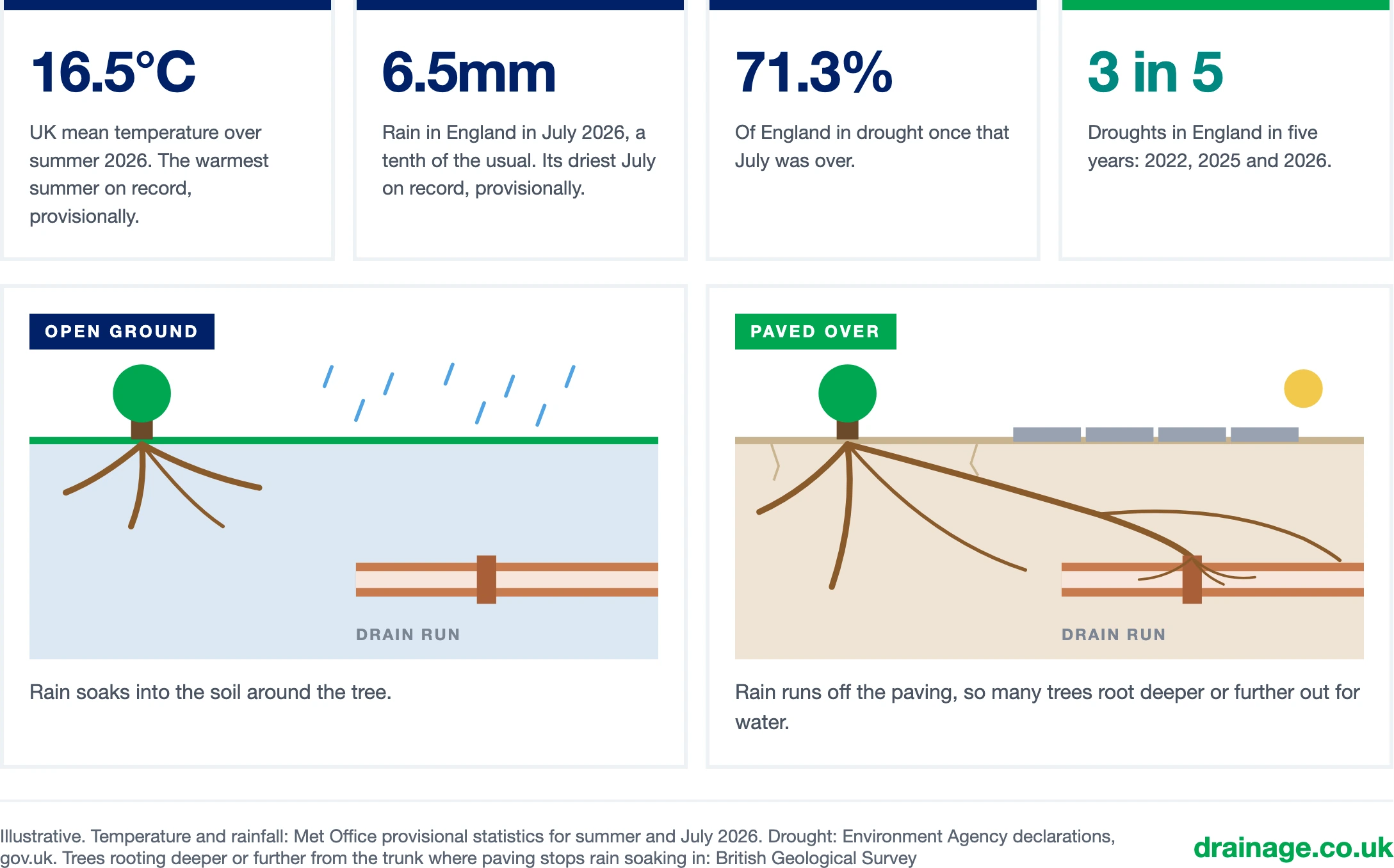
Summer 2026 was the UK's warmest on record, with a mean temperature of 16.5°C, according to provisional figures from the Met Office, the UK's national weather service.
England also had its driest July on record, provisionally, with 6.5mm of rain, 10% of the long-term average for the month. By August, 71.3% of England was in drought, and 2026 is the third drought in five years, after 2022 and 2025.
In strong sunshine, soils lose moisture more rapidly and need more rain to recover. Roots grow towards water, and they will exploit a drain that already leaks.
The Financial Ombudsman Service, which settles complaints between consumers and financial businesses such as insurers, lists tree or plant roots in the pipe among the common types of underground pipe damage it sees.
This guide covers how roots get into a drain, the signs that show up before the pipe fails, what to check in your own garden, how roots are cleared and the pipe repaired, and who pays.
How tree roots get into a drain
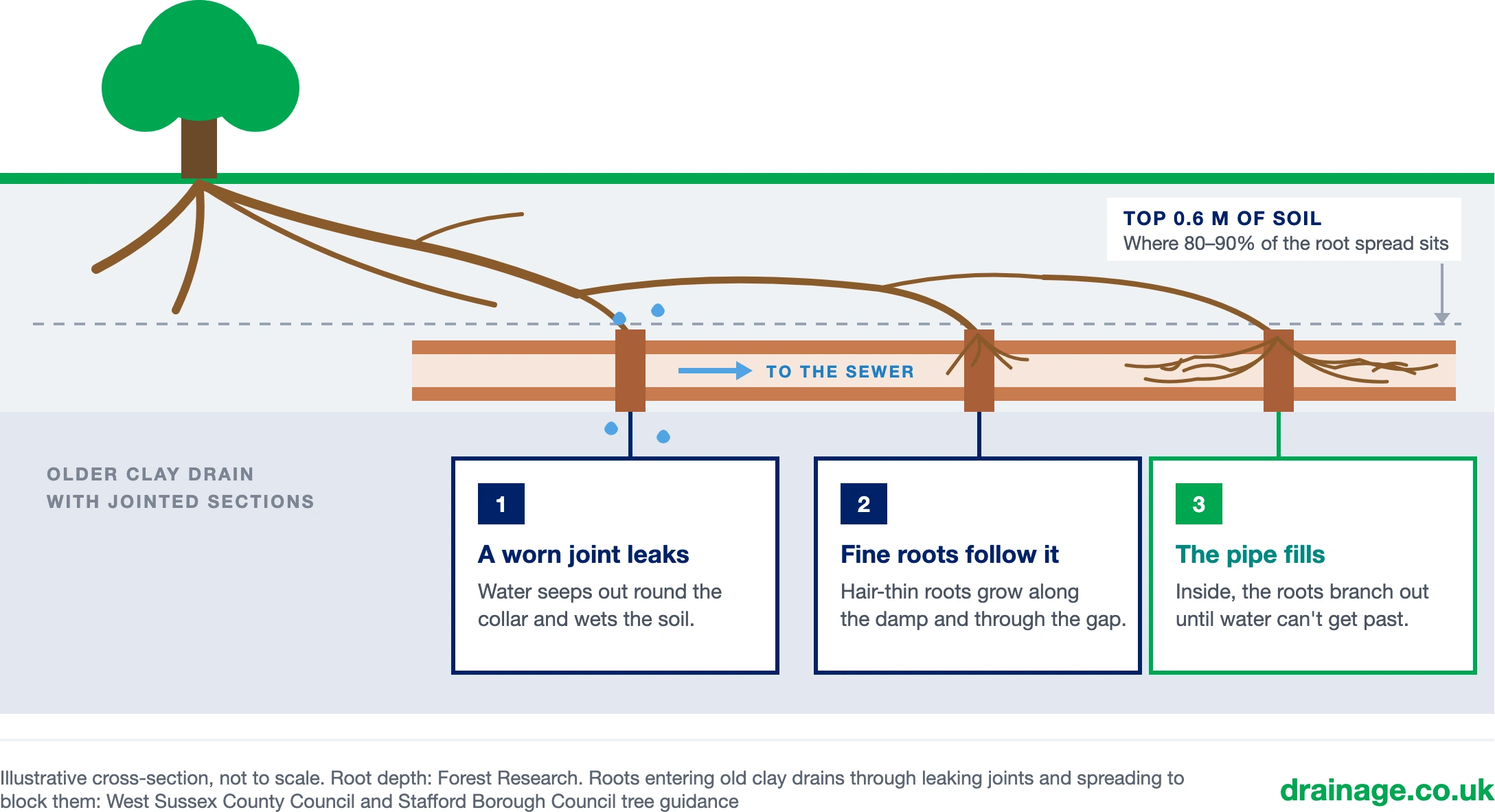
Roots grow towards a water supply, a process called hydrotropism. They also grow along the path of least resistance.
Most of them stay shallow. It is unusual for roots to go deeper than 2 metres, and 80 to 90% of the widespread rooting structure sits in the top 0.6 metres of soil.
Roots follow drains to exploit any condensation on the outside of the pipe, and as they grow they may dislodge a joint and get in. It is more usual for roots to enter a drain that is already damaged.
Drainage problems generally occur with old clay pipes, which can degrade and leak from the joints, allowing roots to infiltrate and then proliferate to block the pipe. As roots grow and thicken in a limited space, they can distort and break man-made structures, including pipes.
For new building work in England, Approved Document C, the government's guidance on site preparation under the Building Regulations, says below-ground drainage should be able "to accommodate the presence of any tree roots", and that "joints should be made so that roots will not penetrate them".
Why dry summers bring roots into drains
Tree roots take up water and dry the soil out. The clay shrinkage that follows happens predominantly during spring and summer, according to the British Geological Survey, the public body that studies the UK's ground and geology.
Where paving cuts off the rain, many trees send their roots deeper or further from the trunk to find water, and draw it from a larger area around the tree. The effect may be made worse because trees continue to extract water during the growing months, when rainfall is low.
This year, by mid-August, parts of England and Wales had received around 150mm less rain than average since April.
Clay shrinks as it dries and swells as it wets, and that ground movement may damage pipes. The formations most prone to it are mainly in the south-east of Britain. A joint opened by moving ground is the kind of leak roots grow into once they reach a drain.
The Met Office expects summers to become both hotter and drier. Projections published in June 2026 put over 1.8 million British properties at high or extreme likelihood of clay shrink–swell by 2070 under a medium emissions scenario, and more than 26% of properties in London.
The warning signs, earliest first
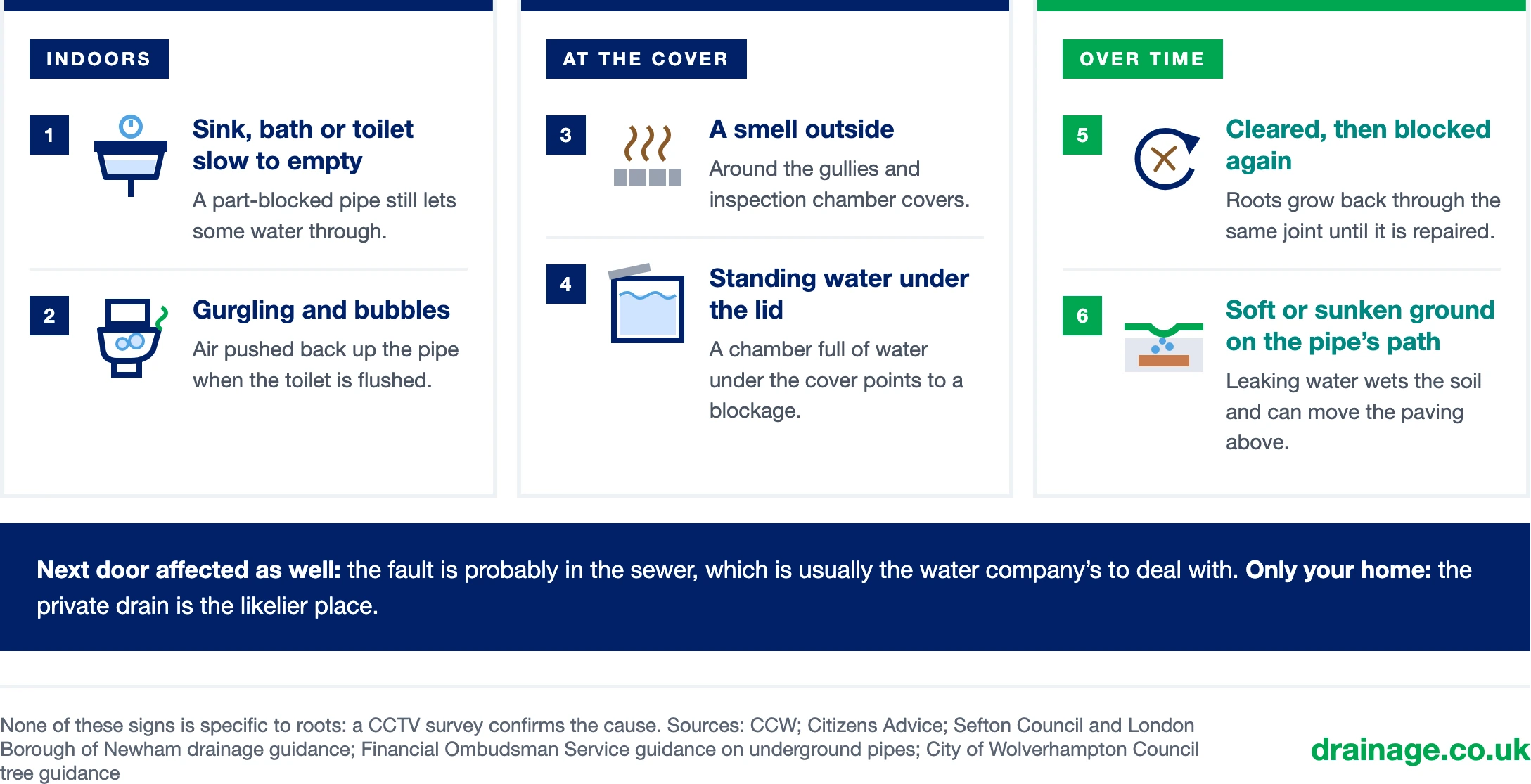
Each of these signs points to a drain that is partly blocked or leaking, whatever the cause. Roots become a likely cause when the signs appear on an older clay drain with a tree near its line, and a CCTV survey of the pipe's condition is how you confirm it.
- Water drains slowly. A pipe can be partly obstructed and still carry water. CCW, the independent body that represents water customers in England and Wales, lists water draining slowly and bubbles from the bottom of the toilet as signs to act on.
- Gurgling. When a drain outside is even partly blocked, water from a flushed toilet pushes the air in the pipe back up. The result is gurgling in the traps and the toilet, and a toilet that is slow to drain.
- A smell. The air in a blocked drain turns pungent, and you may notice a smell around drains and inspection chambers outside.
- An inspection chamber holding water. An inspection chamber on your property full of water, or an outside gully overflowing, points to a blocked drain or sewer. Lift the cover on the chamber in your drive or garden to check.
- A blockage that comes back. Cutting the roots out clears the pipe, and repairing the joint they came through stops them returning. Council tree guidance says repairing the pipe is the only certain way to stop roots getting into a damaged one. A drain that blocks again after clearing is one of the early signs of a failing drain.
- Damp ground or sunken paving along the drain line. A cracked pipe lets water escape into the sub-soil. A leak into the ground can lead to uneven or cracked paving, damaged walls and subsidence.
If a toilet is hard to flush, don't flush it again, because this could flood the inside of your home. Then check next door. If none of your neighbours are affected, your drain is probably blocked. If they are also affected, the problem is probably in the sewer, which is usually the water company's responsibility.
Checking your drain before roots get in
A few checks tell you whether your drain is exposed to roots before any sign appears.
Find out what your drain connects to. Your sewerage company must make a sewer map available if you ask, and your deeds can help show whether the sewer serving your home is public or private.
Note what grows near it. The water industry's design standard for new sewers says a sewer or lateral drain should not be closer to trees than the canopy width at mature height, unless special protection measures are provided. It is written for new pipes in England.
Some species carry more risk. One London council's building control guidance names willow, poplar, sycamore and cherry as trees to avoid planting where pipe routes are known.
Know what the pipe is made of. Old clay pipes can degrade and leak from the joints, so an older house with clay drains and a mature tree near the line is the first to check. A CCTV survey records the condition of the pipe, including any roots.
Plant and prune with the drain in mind. Trees planted too close to a building can damage its foundations or drainage, and a wall shrub or climber may suit a tight space better. The British Geological Survey advises taking expert advice before planting trees near a house, and not removing mature trees that pre-date the house without advice.
Crown reduction or thinning may be better than removal, because it keeps the soil moisture stable. Cutting trees back too hard can leave the ground over-saturated so that it swells, which is called heave.
Root killers, root cutting and repairing the pipe
Root killer. A product that kills plants, roots included, is a herbicide. Herbicides are plant protection products, and they must be authorised before they are used, sold, supplied or stored. The Health and Safety Executive (HSE), the national pesticides regulator, tells home gardeners never to pour them down a drain, sink or toilet, because of the risk to water and wildlife, and warns that you could face prosecution.
Using a product that is not authorised is illegal. If a product is not on HSE's garden database, it is probably no longer authorised.
Cutting the roots out. Roots are removed from a drain with a mechanical cutting tool or a high-pressure water jet, after which a CCTV survey is usually carried out to check for structural damage.
Repairing the pipe. Replacing old clay pipes with modern jointless plastic pipes permanently resolves the problem. A repaired pipe can be protected with special materials to stop damage recurring.
In England, repairs to an existing drain should be carried out to the same standards as new drains. In England and Wales, anyone repairing or reconstructing an underground drain that connects to a sewer must give the council at least 24 hours' notice, except in an emergency. Ask whoever is doing the work to confirm it has been given.
Who is responsible when roots block a drain
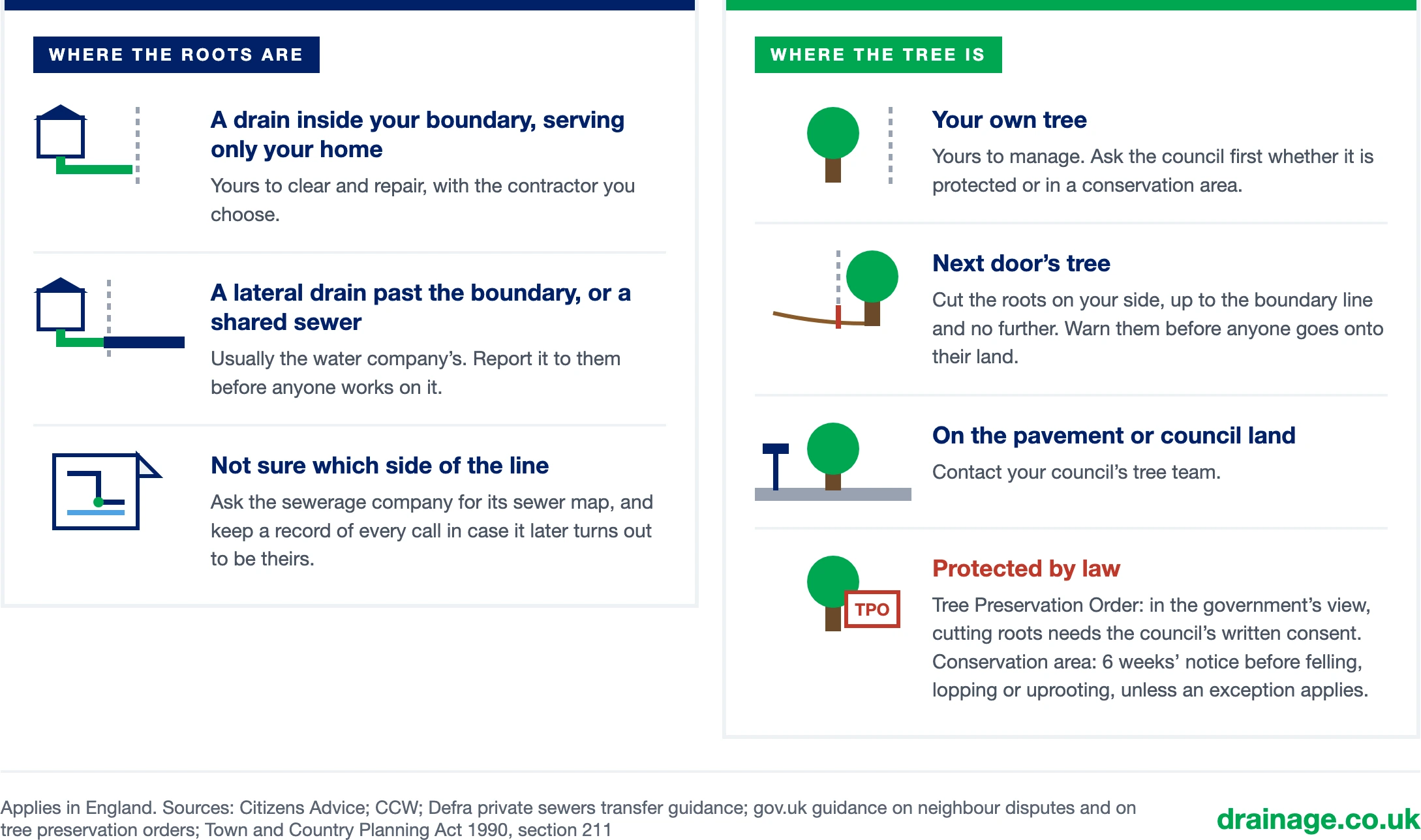
Two questions decide it: whose pipe the roots are in, and whose tree they came from. The rules below apply in England.
The pipe
- Your responsibility: the drain inside your boundary that serves only your property. You pay for the work and choose who does it.
- The water company's responsibility: a lateral drain, which serves your property but lies outside your boundary, and a shared sewer connected to the public network. Most of these passed to the water companies on 1 October 2011, though some private sewers remain. If one is blocked, contact your water company.
An occupier can commission work only inside the private drain. Work in the public sewer or lateral drain needs contact with the water company first, to confirm how to proceed.
The tree
- A neighbour's tree: you can trim roots that cross into your property, but only up to the boundary. If you go further, your neighbour could take you to court.
- A street or council tree: contact the council that owns it. A roadside tree may belong to the county council, and you can find your council through gov.uk.
- A protected tree: a Tree Preservation Order bans cutting down, topping, lopping, uprooting and wilful damage without the council's written consent, and the government's view is that cutting roots also requires consent. It applies even if the tree is yours.
In a conservation area, work that an order would control, including cutting down, lopping, uprooting or wilfully damaging a tree, needs 6 weeks' notice to the council where the tree has no order, unless an exception applies.
Cutting down, uprooting or destroying a protected tree carries an unlimited fine, and lesser breaches carry a fine of up to £2,500.
An application to work on a protected tree because it is damaging drains should be backed by technical evidence from a relevant engineer, building or drainage surveyor or another appropriate expert. A CCTV survey report can form part of that evidence.
If you rent, your landlord is always responsible for repairs to pipes and drains. Our landlord's guide to drainage responsibilities covers the landlord's side, and our guide to who is responsible for a blocked drain explains how to tell which side of the boundary a blockage is on.
Tree roots and your buildings insurance
A blocked pipe can count as damaged through loss of function, meaning water cannot flow through it, even when the pipe itself is not physically damaged.
Cover usually applies only to pipes you are legally responsible for. Roots in the water company's lateral drain are for the water company to deal with.
Gradual damage, wear and tear, and poor design, construction or workmanship are the most common exclusions, and an insurer relying on one has to show it applies.
Where an insurer relies on gradual damage, the ombudsman is likely to say the claim should be paid if the customer could not reasonably have known about the damage and acted as soon as they could.
In one 2025 decision, the relevant part of the policy covered damage to the drains and pipes only. The insurer accepted that a neighbour's tree roots had damaged the drainage and covered it, but did not pay to remove nearby roots that had not yet caused damage.
If the repair is done before the insurer inspects, the claim is not automatically declined, but you will need evidence from your drainage company, such as a detailed report, photos or an itemised invoice.
Underground pipe cover tends to be for the pipe itself, and subsidence is a separate section: most home insurance policies cover subsidence.
Clay is about 30% to 35% water and can dry out when nearby plants absorb it. Where a tree is causing subsidence, an insurer might ask a tree surgeon to cut it back, install root barriers or cut it down.
Our guide to drain damage and insurance covers the exclusions and the report an insurer needs.
How Drainage.co.uk finds and fixes root damage
Drainage.co.uk works 24 hours a day across the UK, from dispatch hubs in ten cities, with a 60-minute emergency arrival target. The work is backed by ISO 9001 certification and SafeContractor accreditation.
A CCTV drain survey finds the roots, the joint they came through, and the distance along the run where they sit. The report shows the pipe material and condition, and places the fault against your boundary so you know whose pipe it is.
Roots are cut out with specialist root-cutting heads and high-pressure water jetting. Where the joint or pipe wall is damaged, trenchless CIPP (cured-in-place pipe) relining forms a new, jointless pipe inside the old one without digging up the garden or drive, and patch repairs fix a single damaged section.
The same report supports an insurance claim, an application to the council to work on a protected tree, and a request to the water company where the roots sit in its pipe. For landlords and managing agents, the survey report records the cause, and a follow-up survey records the repair.
A camera survey shows whether roots are in your drain and whose pipe they are in.
If your drain is slow, gurgling or blocking again after clearing, book a CCTV drain survey with Drainage.co.uk.
Frequently asked questions
How do I know if tree roots are in my drain?
The signs are those of a partly blocked or leaking drain: slow draining, gurgling, a smell or an inspection chamber full of water, and a blockage that returns after clearing. Roots become a likely cause when there is a tree near the drain line, and a CCTV survey of the pipe's condition confirms it.
Can tree roots break a drain pipe?
Sometimes. Roots usually get in through an existing fault, such as an old clay joint that leaks. Once inside they spread. Roots thickening in the soil can distort and break pipes, but council guidance says roots do not usually damage a drain by lifting or girdling it.
Which trees are worst for drains?
Council building control guidance names willow, poplar, sycamore and cherry as species to avoid planting near known pipe routes. The water industry's design standard keeps new sewers in England a mature canopy width away from trees, unless special protection measures are provided.
Can I cut my neighbour's tree roots out of my drain?
You can trim roots that cross into your property, up to the boundary. Check first whether the tree is protected, because the government's view is that cutting the roots of a protected tree needs the council's consent.
Is it safe to use root killer in my drains?
No. Any weedkiller must be authorised before it is used, and the pesticides regulator says never to pour one down a drain, sink or toilet. Doing so risks prosecution, and council tree guidance says repairing the pipe is the only certain way to keep roots out of a damaged one.
Does home insurance cover tree root damage to drains?
It can, for pipes you are responsible for. A blocked pipe can count as damaged through loss of function, and an insurer relying on a gradual damage exclusion has to show it applies.
Who pays if roots block the drain outside my boundary?
In England, a lateral drain or shared sewer outside your boundary is usually the water company's responsibility. Our guide to who is responsible for a blocked drain explains how to tell where your pipe ends.
Technical
Directives.
Our hub maintains precision unblocking protocols across the UK. For immediate site remediation, contact our dispatch specialists.